Month: August 2025

Producers and sellers of recreational nitrous oxide are giving this dangerous product a false sheen of safety and regulation when the harsh reality is frost-bite injuries, irreversible brain damage and even death. And these bad actors in retail stores and event parking lots across the state are not alone. Colorado has documented problems with illegal psilocybin-laced products that made customers sick, THC products sold outside of licensed and regulated stores and kratom, an addictive drug, being sold openly at kava bars.

Denver Post reporters John Aguilar and John Wenzel chronicled this week the easy availability of nitrous oxide — laughing gas — across the Denver metro area. Colorado lawmakers and municipal leaders must take action.

Khalil Simon, leader of a brass band that frequents concert venues to busk for tips, spoke out bravely in The Denver Post about the problem he sees growing at every event.

“I know Colorado’s drug-friendly, but I didn’t know it would blow up like this. Kids are losing their brain cells now that it’s been rebranded,” Simon said. “It’s way worse than weed or anything like that. It straight up makes you dumb.”

Because these products are being marketed and sold by retail stores, users often overlook the dangers, assuming the drugs must be regulated by one of America’s consumer protection agencies like the U.S. Food and Drug Administration. Nothing could be further from the truth.

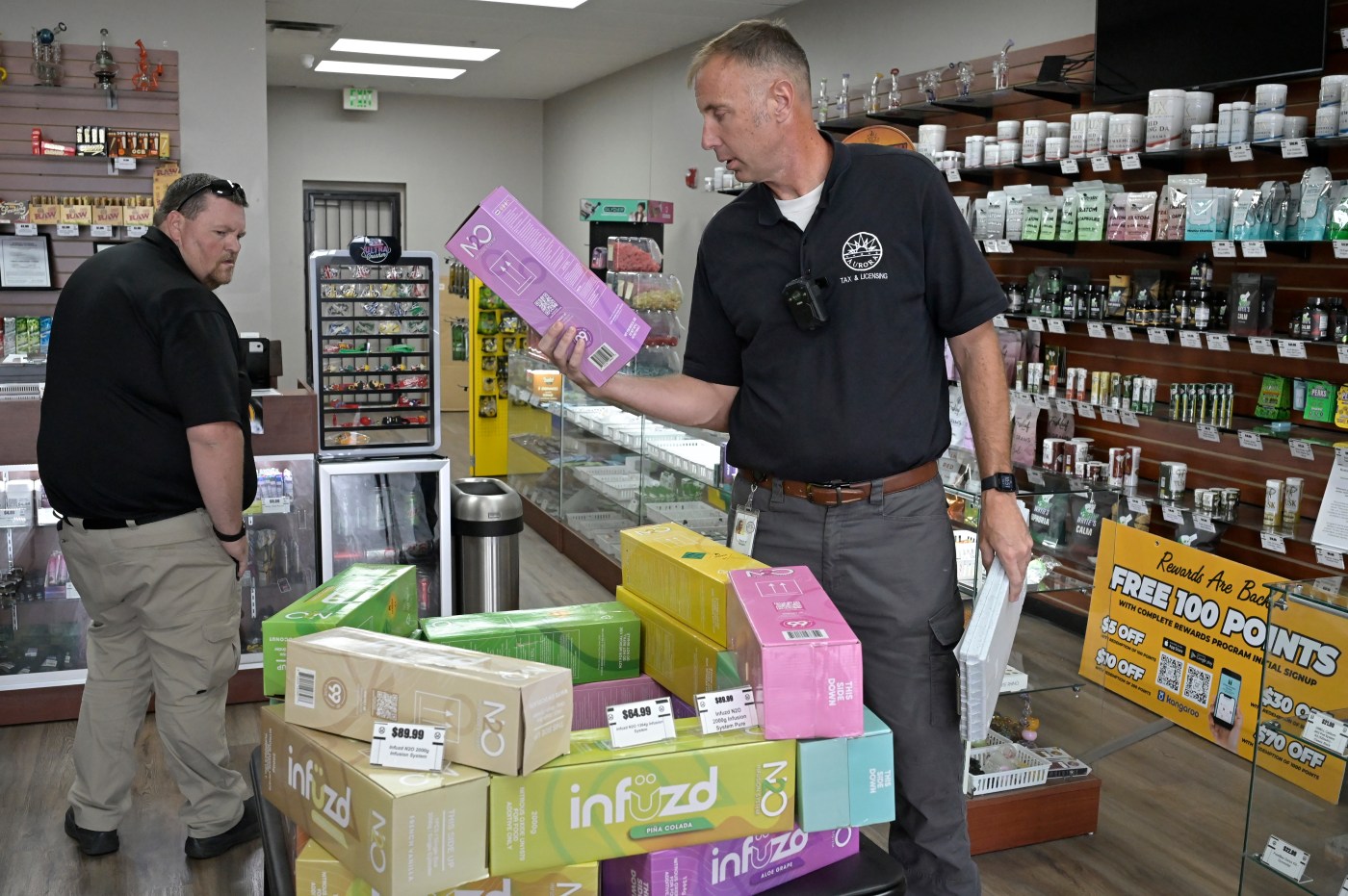
Aurora City Council took the first step this week by cracking down on the open market for nitrous oxide. Convenience stores, vape shops, and head shops sometimes have open displays of nitrous oxide canisters for sale with clever marketing names that are clearly targeting abusers of the product.

Even before the new ordinance passed, The Denver Post followed city officials who were confiscating products suspected of being marketed for illegal use or containing regulated substances from several shops.

This is an important step to protect Coloradans.

Denver City Council should follow.

Lawmakers across the nation have long regulated nitrous oxide. The intent of Colorado law is that laughing gas only be sold to medical professionals and to those wishing to use it for non-consumptive use, like cooking.

Police can save lives and protect teens if they enforce these laws by confiscating canisters of nitrous oxide and issuing tickets. This will be a good start to sending a signal to users and sellers that this dangerous drug will not be tolerated in Colorado.

Officials also shouldn’t stop with nitrous oxide. Although laughing gas poses the most imminent danger to users – death by asphyxiation – kratom is addictive and can also be dangerous for users, causing liver toxicity and seizures, according to the FDA. Yet it is a product openly advertised for sale across the state.

Colorado Senators Kyle Mullica, Byron Pelton and Representatives Mandy Lindsay and Matt Soper passed clear and comprehensive regulations of kratom this year that fell short of banning the sale of the plant-based product, but did at least notify users of the risks and create common dosage requirements.

Coloradans have long held libertarian views of drug use, and our liberal laws make it more important than ever to keep dangerous products out of the hands of teens and to make certain that users know the risks. And some drugs simply should not be abused recreationally because the risks are too great.

Sign up for Sound Off to get a weekly roundup of our columns, editorials and more.

To send a letter to the editor about this article, submit online or check out our guidelines for how to submit by email or mail.

Mayor Mike Johnston, as always, has an aggressive plan to give Denver a boost even as federal funding and state funding recede and the city begins massive layoffs to plug a gaping hole in the budget.

Instead of waiting the typical 10 years to ask voters to approve a slate of big infrastructure projects, Johnston and the Denver City Council will ask voters this fall to approve almost $1 billion for dozens of projects big and small across the city.

The Denver Post editorial board met with the mayor and was skeptical about the need and wisdom of a bond, as well as some of the proposed projects. Why take on more debt now, as the city is about to make painful budget cuts? What about the risk of the economy going south? Wouldn’t it be more prudent to pay for maintenance needs out of the general fund?

We were convinced, however, by the arguments: A city struggling to recover needs investments in its infrastructure. The city has the debt capacity. Failing to seek this bond will not forestall layoffs and budget cuts. A shaky economy is the time Denver most needs an influx that could bring work and development.

Despite the tight time frame, the mayor and council engaged the community to help select projects and provide feedback on proposals, a shortened version of the work that has gone into previous bond proposals.

Denverites also won’t suffer a property tax increase because of the bond issue. Johnston plans to use revenue raised by the existing 6.5 mill levy for past bonds, including the 2017 Elevate Denver Bond. The mill levy usually floats up and down with Denver’s property values to make sure revenue is just the right amount to pay the debt service on historic bonds. Because of booming values, the mill levy has dropped from 8 mills in recent years to service the same debt, and now Johnston would use capacity under the 6.5 mills to take on new debt.

If voters say no, Johnston said the city would not float the mill levy down to reduce taxes, but would instead pay off old debt faster.

The city will get roads and bridges, upgraded recreation centers, repaired library buildings, investments in our many cultural facilities, and a 155-acre park where the old Park Hill Golf Course had operated.

“This represents a balance of things. A lot of them are unsexy projects like rehabbing old recreation centers and libraries that don’t have air-conditioning that works or reading rooms that are accessible,” Johnston said. “But those are deeply important to those places and people in neighborhoods who rely on them.”

For example, two of the city’s outdoor pools — Cook Park and Harvey Park — would get much-needed rehabilitation dollars.

A few shiny new projects will interest voters regionally, such as a new $1.9 million bike park to be located somewhere in southwest Denver and $20 million to acquire and build a skate park in southeast Denver that could one day also house a new recreation center. An American Indian Cultural Embassy, a project for which there are still few details, will get $20 million to begin planning.

The most controversial part of the proposal is also the most expensive. Two separate projects will add connectivity to the towering 6th Avenue and 8th Avenue bridges east of Interstate 25 to support some future proposed development at Burnham Yard. Currently, both bridges “fly over” a huge section of undeveloped land just west of downtown, which made sense when it was an industrial rail yard, but will hinder any future development in the area.

By now, most Denverites know that the Denver Broncos’ ownership team is highly considering acquiring the dilapidated and contaminated Burnham Yard site from the state to build a new stadium and entertainment district.

The plans to lower the portion of the 8th Avenue viaduct down to grade-level through Burnham Yard is the single most expensive item on the list, coming in at a cool $89.2 million for a road that sees about 14,000 vehicles a day.

Meanwhile, on-ramps and off-ramps will be added to 6th Avenue to “improve connectivity, capacity and efficiency” on one of the city’s busiest thoroughfares, where 64,000 vehicles pass into and out of the city on a daily basis.  The cost will be about $50 million.

Even if the Broncos decide not to call Burnham Yard their new home, these projects need to be done. Both bridges need repairs, and unless the land under these overpasses is connected to the city, development may not occur for decades. If the Broncos do buy Burnham Yard, the team should share in the costs of these needed infrastructure investments for their project.

The Vibrant Denver GO Bond projects will accomplish much for a city that is struggling due to an onslaught of external and internal factors. Money flowing into our local economy will help create jobs and Johnston said some of the funding will help save city jobs by creating more work for internal departments to handle.

We don’t love everything on the list – but Denver City Council did a good job of parsing through and setting priorities as best they could.

We hope voters say yes, this fall.

Sign up for Sound Off to get a weekly roundup of our columns, editorials and more.

To send a letter to the editor about this article, submit online or check out our guidelines for how to submit by email or mail.