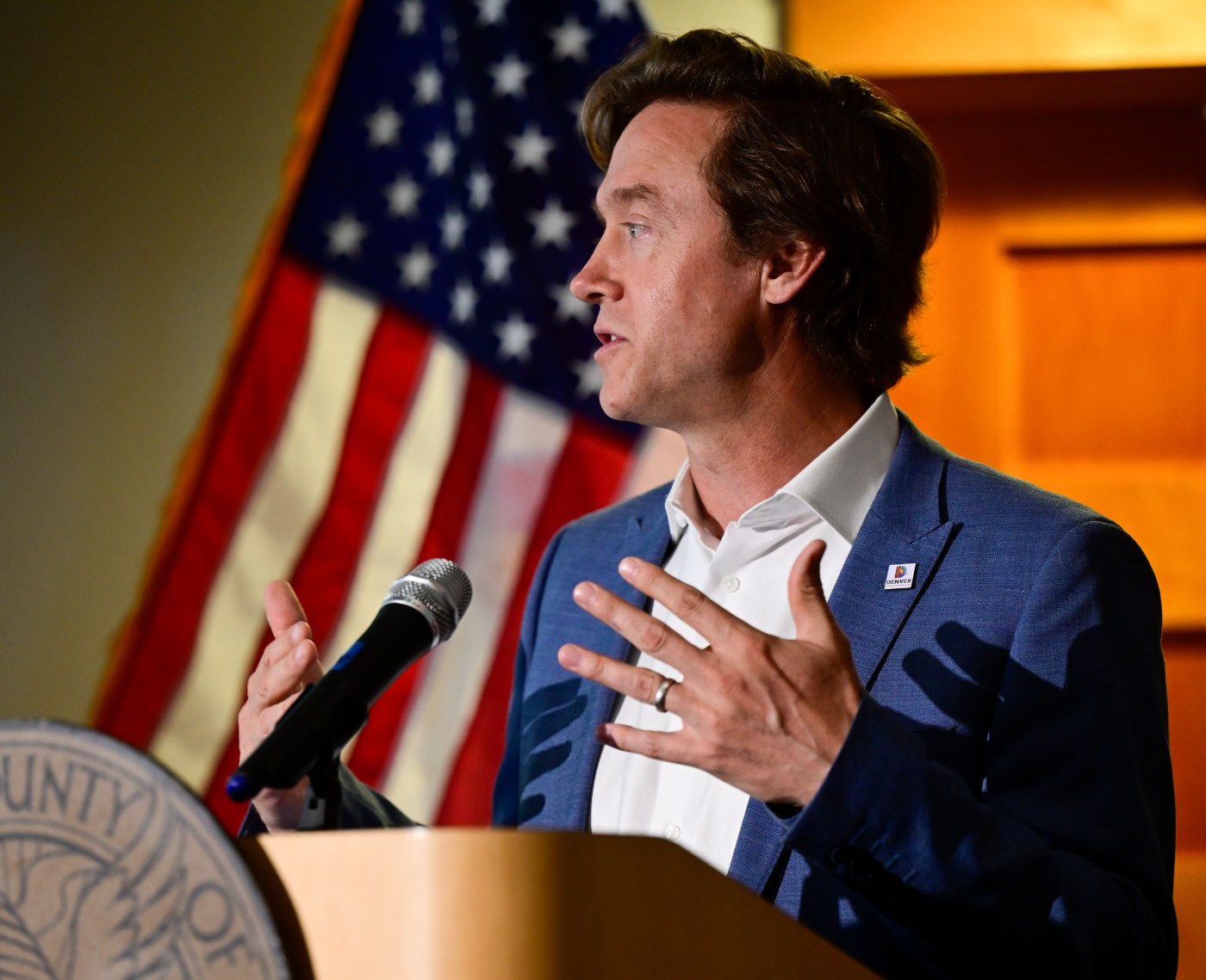
Month: September 2025

Denverites should keep one thing in mind at the ballot box this November – Denver Public Schools has some of the very best schools in the state and also some of the very worst schools in the state.

Testing data released this month highlighted many bright schools in the district, and Superintendent Alex Marrero should be very proud that the district’s students are catching up to their pre-pandemic peers.

However, the data also made something else starkly clear: School choice has never been more important for our children’s educational opportunities. Two schools only miles apart can have dramatically different outcomes for students who enter a classroom at the same level. Because school districts have started measuring and emphasizing growth, we now know where student growth in math and reading excels and where it is stagnant.

There are some candidates running for the Denver Board of Education who would rather see the district’s world-class lottery system go away. Or even if they want to keep the lottery, they want to keep the best schools in Denver a secret by making student growth data difficult to find and even harder to analyze.

We must protect and expand Denver’s universal lottery system for school enrollment. The lottery is not perfect but it is far better than the alternative – students locked out of attending top-performing schools by difficult-to-navigate enrollment procedures that vary school to school.

This November voters will have a critical choice to make – do they support Denver’s lottery system, where any student can attend any school they want with one easy form, or do they want a student’s academic quality to be determined by their home address?

We’re afraid the two dark-money groups attempting to buy this election aren’t asking that question. Instead, they are focused on whether candidates support charter schools or district-run schools, and whether or not the candidate is supportive of the Denver Classroom Teachers Association — a union — or not.

The problem is that the ideal candidate will be independent enough to buck the union when it is wrong, and strong enough to stand up to failing charter schools and demand accountability. In short, the endorsement of either group – the Denver Classroom Teacher Association’s Action and the Denver Families Action – is a dark mark on a candidate’s résumé.

We need candidates who will demand that the district present every school’s student growth data on their website – regardless of whether it’s a charter school or a district-run school.

We need candidates who will support and expand the school choice lottery so that it is more equitable.

We need candidates who will wrap neighborhood schools in services and funding to ensure that students who don’t have access to transportation to exercise choice get the very best education possible, even if their school is not seeing the same student-growth results as peer schools.

We need candidates who will find ways to provide transportation to students using school choice.

We need candidates who will not squabble with the district’s excellent charter schools but will partner with them to expand their success.

We need candidates who will return autonomy to innovation schools and find other creative ways to break the mold of underperformance.

And finally, we need candidates who will end the cycle of embarrassment where personal grievances, unprofessional behavior, and mistreatment of district staff only distract from the important work.

Let’s reframe this election and make it about things that matter this school year to every single student. School choice enrollment begins and ends early this year on Dec. 2 and Jan. 20, 2026. With the election leading up to the lottery, every candidate must tell voters where they stand on the issue.

Sign up for Sound Off to get a weekly roundup of our columns, editorials and more.

To send a letter to the editor about this article, submit online or check out our guidelines for how to submit by email or mail.


The tragedy at Evergreen High School reminds us that even this country’s most idyllic communities — from our mountain towns to the quaint cities on the plains — must prepare for violence in their schools. School shootings have never been only an inner-city problem, and to believe otherwise is to ignore Colorado’s tragic history.

We were dismayed to learn that security at Evergreen High School may not have been a priority because of the school’s location about an hour west of Denver in the forested foothills of Jefferson County.

Mental illness and radicalization can occur anywhere, especially in a society connected seamlessly online to every type of content imaginable.

Every school in this state needs a dedicated resource officer who can respond immediately to a threat on campus.

Seconds matter in a shooting, and two students from Evergreen High School are in the hospital fighting for their lives. Jefferson County Sheriff’s Deputies responded quickly to the shooting but even that was unable to prevent tragedy.

The evening before the shooting at Evergreen High School, the school’s principal told concerned parents that a school resource officer had been “deprioritized” for Jefferson County’s mountain schools. The school’s full-time deputy was on medical leave, and the contract with the Jefferson County Sheriff’s Office has a deputy on campus “as staffing allows.” At the time of the shooting, the officer assigned to the campus was responding to a call off campus.

Every Colorado school needs an armed officer on campus during school hours. We are glad the Jefferson County School District will increase security before students return, and a similar plan should be put in place at every school in the state.

School violence has struck a charter school in the suburban community of Highlands Ranch where a road is now named for the hero — Kendrick Castillo — who saved his classmates but died. A few miles north at Arapahoe County High School in Littleton, Claire Davis was shot and killed by one of her classmates. Two teachers were shot and injured in the middle of Denver at East High School, and another student was shot and killed in the school’s parking lot a few weeks earlier.

But small towns, rural communities and the mountains are not immune. In 2006, a gunman took students hostage at Platte Canyon High School in Bailey, about a half-hour drive from Evergreen on twisting mountain roads. Emily Keyes was shot and killed.

We understand having law enforcement in every school in this state is a challenge financially and logistically, but in the face of yet another school shooting, we don’t see another option.

Americans can no longer be complacent. Our schools are not safe, and while locking down Evergreen quickly undoubtedly saved lives, we know that having a trained police officer on campus reduces the response time to seconds.

The teenager who shot two classmates and then killed himself last week had been active online in what experts describe as a new nihilism — the belief that life is meaningless — combined with a twisted desire to destroy society.

The teen’s social media accounts contained antisemitic and white supremacist posts and glorified other school shooters. According to the Jefferson County Sheriff’s Office, the teen had been “radicalized through an extremist network.”

The only response is to harden our schools and protect as many students as possible. Of course, statistically, it is still unlikely that a student will be harmed in an act of violence on campus. The riskiest part of a student’s day is still apt to be their drive home.

But just as we require our children to ride in car seats, wear seatbelts and often buy them their first cars with airbags and other safety features, so too must we make schools as safe as possible.

We pray the victims of this shooting — 18-year-old Matthew Silverstone, and a second student who has not been identified at the behest of his family — survive and thrive.

And we pray that the next time someone targets our schools with violence that they are met by a show of force from law enforcement that protects innocent life.

No place is immune from school violence, a lesson we thought Colorado learned long ago when 12 students and a teacher were killed at Columbine High School.

Sign up for Sound Off to get a weekly roundup of our columns, editorials and more.

To send a letter to the editor about this article, submit online or check out our guidelines for how to submit by email or mail.

Americans are recoiling from the Democratic Party, and even in blue states like Colorado, Democrats are feeling the burn.

With Republicans fielding the best candidate for governor they’ve had in a decade – Sen. Barbara Kirkmeyer – liberal politicians would be wise to address the root causes of this dissatisfaction publicly, frequently and head-on. The reality is that Americans are struggling — our politics are becoming more violent, everything is more expensive, and the job market is tightening.

After years of enjoying popularity, Colorado’s top Democrats are now showing a remarkable drop in their approval ratings among voters. President Donald Trump remains deeply unpopular in the state, but Gov. Jared Polis, Sen. Michael Bennet and Sen. John Hickenlooper are failing to break a 50% approval rating, meaning more of those asked than not said they were unhappy with the politicians’ work.

Unaffiliated voters claim outright majority of Colorado electorate

/*! This file is auto-generated */!function(d,l){“use strict”;l.querySelector&&d.addEventListener&&”undefined”!=typeof URL&&(d.wp=d.wp||{},d.wp.receiveEmbedMessage||(d.wp.receiveEmbedMessage=function(e){var t=e.data;if((t||t.secret||t.message||t.value)&&!/[^a-zA-Z0-9]/.test(t.secret)){for(var s,r,n,a=l.querySelectorAll(‘iframe[data-secret=”‘+t.secret+'”]’),o=l.querySelectorAll(‘blockquote[data-secret=”‘+t.secret+'”]’),c=new RegExp(“^https?:$”,”i”),i=0;i<o.length;i++)o[i].style.display="none";for(i=0;i<a.length;i++)s=a[i],e.source===s.contentWindow&&(s.removeAttribute("style"),"height"===t.message?(1e3<(r=parseInt(t.value,10))?r=1e3:~~r<200&&(r=200),s.height=r):"link"===t.message&&(r=new URL(s.getAttribute("src")),n=new URL(t.value),c.test(n.protocol))&&n.host===r.host&&l.activeElement===s&&(d.top.location.href=t.value))}},d.addEventListener("message",d.wp.receiveEmbedMessage,!1),l.addEventListener("DOMContentLoaded",function(){for(var e,t,s=l.querySelectorAll("iframe.wp-embedded-content"),r=0;r<s.length;r++)(t=(e=s[r]).getAttribute("data-secret"))||(t=Math.random().toString(36).substring(2,12),e.src+="#?secret="+t,e.setAttribute("data-secret",t)),e.contentWindow.postMessage({message:"ready",secret:t},"*")},!1)))}(window,document);

These results from a poll conducted in early August of 1,136 registered Colorado voters by Magellan Strategies mirror what we are seeing across the nation. Americans are dissatisfied.

According to a New York Times analysis of available voter registration numbers, the Democratic Party is hemorrhaging voters across the board and particularly in swing states. Meanwhile, the Republican Party is gaining voters after years of losses.

Part of the shift is voters simply changing their affiliation to unaffiliated, but the Magellan Poll clearly indicates that there is more afoot than voters just looking to participate in open primaries.

Magellan, a conservative-leaning Colorado firm, found that among voters who supported Kamala Harris in 2024, 47% have unfavorable opinions of the Democratic Party.

To be clear, voters who were polled still said they were more likely to support a Democrat for governor next year. Only 38% of those polled said they would likely support a Republican for governor. Kirkmeyer has an uphill battle to be certain, but her opponents are weakened.

We’d hazard a guess that the non-existent Democratic primary in 2023 to challenge a sitting president who was showing cognitive decline while in office is part of the reason voters are upset. It will take time for voters to forgive – and no one will ever forget – the disastrous presidential debate.

But national politics can’t take all the blame.

Gov. Jared Polis has served almost eight years in office and 52% of voters told pollsters that they had an unfavorable opinion of his work, and 35% strongly disapprove. That is softened only by the fact that 56% of voters polled strongly disapproved of the job President Donald Trump is doing, but Colorado has rejected Trump three times in general elections and the Republican Party rejected him in the 2016 caucus.

U.S. Sen. Michael Bennet is doing slightly better with 44% of voters reporting disapproval of him, and U.S. Sen. John Hickenlooper was at 49%.

Bennet is going to face Attorney General Phil Weiser in the Democratic Primary for governor. Weiser wasn’t included in the poll and neither were any of the Republican candidates.

The bottom line is that Democrats cannot spend this election talking about Donald Trump, and pretending that voters don’t have real concerns about the governance of both political parties. Voters may still put many or even most Democrats into office, but if the party wants to recover, its top leaders must start this election cycle with something more than fear and loathing.

Coloradans are concerned. The Magellan poll found that 54% of voters anticipate the economy will decline in the next 12 months (with more Democrats expressing this fear than Republicans), a pessimistic view that requires our politicians to articulate a plan for the worst-case scenario.

Similarly, 54% think Colorado is headed in the wrong direction (with more Republicans unhappy than Democrats), and the high cost of living, public safety, and homelessness were mentioned frequently by voters as top concerns, according to Magellan. These issues will only be harder to address given the decline in federal, state and local revenue sources. Our next governor will articulate a feasible plan.

Finally, Democrats will win safe seats in 2026 with their heads in the sand, but if the party wants to gain ground in swing districts, its politicians are going to have to step up to the challenge at hand – restoring faith in and favorability of the party. Can that be done without rehashing the many missteps of the past four years? We would like to see elected officials be accountable and transparent.

But Colorado must move forward, as must the nation.

If Democrats want to stop losing ground, they’ve got to appeal to voters as far more than an alternative to Trump.

Sign up for Sound Off to get a weekly roundup of our columns, editorials and more.

To send a letter to the editor about this article, submit online or check out our guidelines for how to submit by email or mail.
The Broncos are poised to stay in the heart of Denver, and that is an announcement that all of Colorado can celebrate, even if they’ve never cheered for the orange and blue.

Greg Penner, CEO of the Broncos, announced Tuesday morning that the football team’s ownership group plans to spend billions of dollars transforming an abandoned railyard just southeast of downtown into a new stadium and entertainment district.

In an exclusive interview with The Denver Post, Gov. Jared Polis, Mayor Mike Johnston and Greg Penner shared a vision for Burnham Yard that is far more than just another billion-dollar stadium project in a country that financially, and often emotionally, supports 32 teams in the National Football League.

“Sometimes you need constraints,” Penner said, explaining that his team was drawn to Burnham Yard by the possibility of using some of the existing buildings, rusted equipment, and even the old switchyard.

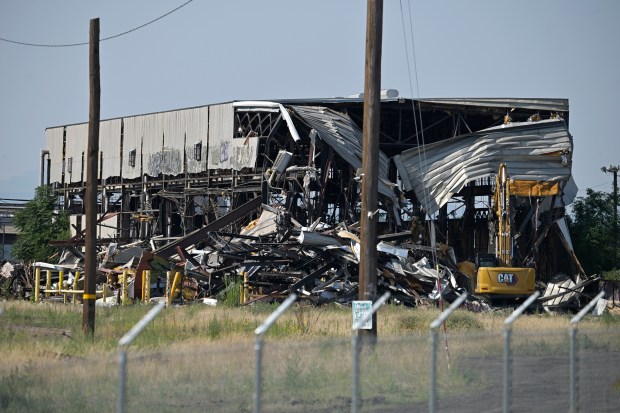
Those constraints include contaminated land, historic buildings, a working rail line, and acquiring splotches of land one at a time to reach about 100 acres that Penner and his group have quietly spent the last year acquiring in a city where less than a quarter acre of land sells for about a half-million dollars. We can see how the constraints on the site will lend themselves to an authentic project that feels less like a privately owned utopia and more like a natural extension of the city’s core.

If everything comes together the Broncos stadium at Burnham Yard will give Denver a state-of-the-art venue that can compete for tourism-generating events year-round, a transit-oriented development that offers visitors alternative means of fast, easy transportation, and a revitalized part of the city that is now a blighted brownfield.

Our biggest concern with this location was the need for Denver Water to move some of its operations, including brand new buildings, and sell the land to the Broncos as part of their 100-acre footprint. The CEO of Denver Water, Alan Salazar, assured us early on that he would not let the project increase water rates.

Fortunately, Penner and Johnston said the final agreement will make Denver Water whole. The new Denver Water headquarters building will remain where it is, but the Broncos will acquire new land for Denver Water’s operations equipment and repair facilities, and pay for the new buildings on the site.

Demolition work is underway on a building at Burnham Yard in Denver on Friday, July 25, 2025. (Photo by Hyoung Chang/The Denver Post)

“This was a good outcome,” Penner said. “But also Alan (Salazar) and his team were very tough, so it was not an easy one to get to resolution.”

We appreciate everyone’s diligence in getting to this point where Burnham Yard — despite and because of all the complications and constraints — is the preferred location for the new Broncos stadium.

Penner’s vision is that the new stadium and entertainment district will embrace the history of Burnham Yard, maintaining some of the existing buildings and even some of the historic equipment to make this project so much more than another mixed-use development. Too often, developments of this size that pop up on virgin ground get lost to boring cookie-cutter street scaping and architecture. But the Broncos’ owners aren’t building a Disneyland an hour south of Denver where the “Mainstreet” will look just like the one outside Orlando.

Polis and Johnston deserve credit for bringing 58 acres of state-owned land to the table. The project supports urban infill and it will capitalize on the existing light-rail station at the location and future plans for a Front Range Passenger Train that drops off commuters from north and south of the Denver Metro Area.

“This is a chance to showcase transit-oriented development in a very special place,” said Polis, who has used his influence during his two terms in office to champion our fledgling rail system and public transportation.

Denver Mayor Mike Johnston emphasized the win for Colorado that not only will the 58 acres of Burnham Yard be reborn after having sat vacant for 10 years, but also the 80 acres under the existing Empower Field and Mile High Stadium will revert to city ownership, creating a once-in-a-lifetime opportunity for the city to direct its own development, including providing affordable housing in a city where all but the most affluent buyers have been priced out.

All three men cautioned that there was a risk the project could not move forward as envisioned. Some parcels of land still must be acquired and obviously the Broncos’s owners need to finalize their design and architectural plans.

But we would rather celebrate too early than let the moment slip by.

The preferred alternative, should this plan be stymied by environmental remediation costs, neighborhood opposition, or bungled land sales, is in Lone Tree. That is about an hour south of the city center, but Lone Tree is a small town that will continue to thrive even without a multi-billion-dollar investment from the Broncos.

Finally, we would like to celebrate that the Broncos’ plans expose the public to much less risk than other projects. For example, Las Vegas financed almost half of the Raiders’ $2 billion stadium with a hotel room tax.

Both Polis and Johnston emphasized that the Broncos’ owners did not want a taxpayer-funded stadium and that the redevelopment project would not require a tax increase of any sort.

But we do urge some caution and restraint as this project rolls forward with an aggressive timeline that could have the Broncos playing their first game in the new stadium in 2031.

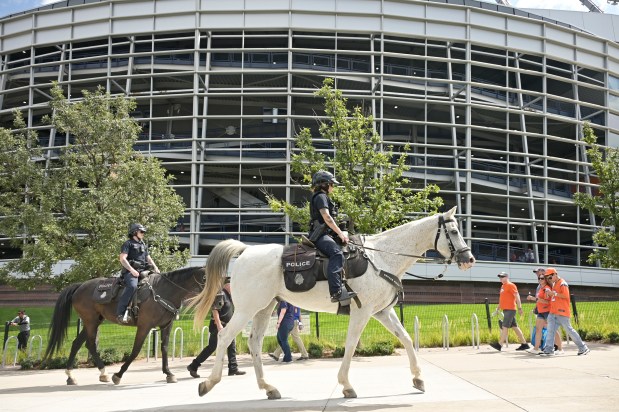
Denver Police officers patrol outside the stadium with horses at Empower Field at Mile High in Denver on Sunday, Sept. 7, 2025. (Photo by Hyoung Chang/The Denver Post)

Polis and Johnston can be extremely transparent about the subsidies for this project. Are the Broncos going to pay fair market value for the state-owned land and the nearby parcel owned by Denver Water? Will the Broncos’ owners be granted taxing authority to levy higher property taxes and sales taxes on future homeowners and businesses in Burnham Yard? How many tax subsidies will the Broncos receive from the city and state?

Penner, Polis and Johnston said it is far too early to answer those questions, as there isn’t even a site plan for the development yet. Long before a special district or metropolitan district gets approved, the Broncos’ owners must begin the planning process for zoning approvals. Tax increment financing won’t be an option until the Department of Urban Renewal completes its assessment of the land. It has become a given, however, that every developer on the Front Range be given taxing authority by the city or county, and it is likely that this project will also qualify for tax breaks due to the nature of the remediation needed on the land.

Those concessions to the Walton-Penner Ownership Group could transform Burnham Yard into a vibrant community that fits seamlessly with the existing neighborhood, while freeing up 80 acres at the old Mile High site for a housing project directed by the City of Denver. The benefit will far outweigh the costs and the Broncos will remain right where they belong, only a few miles from the historic Mile High location and close to the beating heart of the city.

Sign up for Sound Off to get a weekly roundup of our columns, editorials and more.

To send a letter to the editor about this article, submit online or check out our guidelines for how to submit by email or mail.
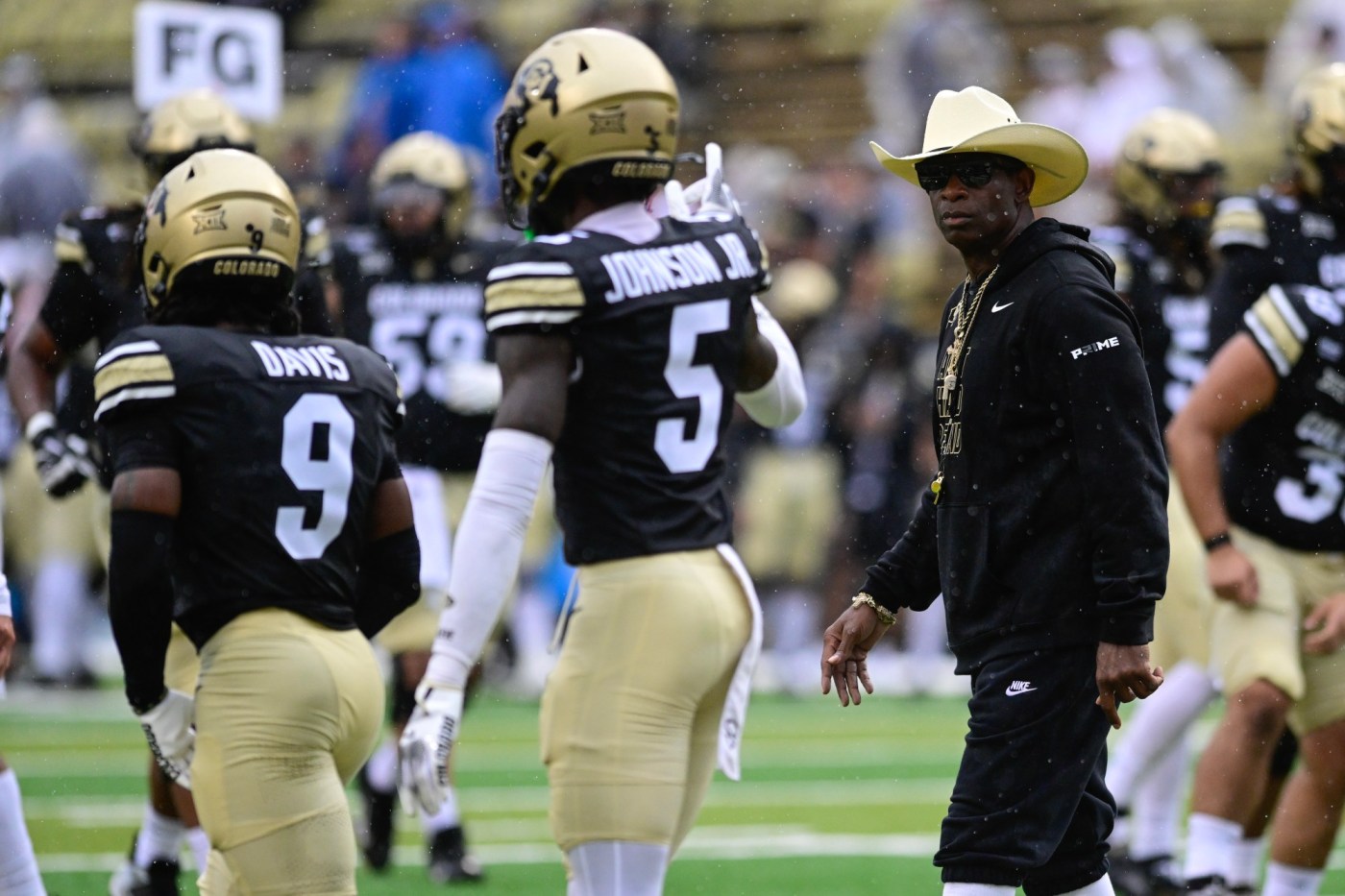
College amateur hour is dead. Long live the revenue-sharing arms race.  

Starting this fiscal year, colleges and universities are now able to directly pay their student athletes thanks to the so-called House settlement. The multibillion-dollar settlement ended three antitrust lawsuits against the NCAA that claimed the organization was limiting the earning power of college athletes. 

Along with the 2021 name, image and likeness changes that allowed players to be compensated by third parties for their personal brand, the House settlement is helping to address the historic exploitation of the talents of college athletes. CU Boulder made nearly $35 million in football ticket sales during the 2024 season — that’s not possible without these student-athletes. 

But for all the positives that NIL and the House settlement are bringing to college athletics, they have also opened a financial can of worms. Running an athletics department was already an expensive endeavor; now, if schools are keen to compete, they must rustle up tens of millions of dollars to pay their players. 

In other words, the cost of glory just got a lot more expensive. 

So, as we hurtle into this new frontier, CU Boulder must refrain from throwing caution to the wind. There may be money to be made and bowl games to win, but our state’s flagship university must remember that, first and foremost, its mission is one of education. 

Schools that opted into the House settlement’s revenue sharing can now spend up to $20.5 million paying athletes this year. That figure will increase annually by 4% until it hits $33 million in 2035. 

That $20.5 million cap is designed to prevent wild overspending by the richest schools in order to maintain the semblance of fair play. But there is no obligation for a school to spend that much paying its players. For its part, Colorado State University says it is going to ramp up to the cap. CU, though, is planning on going all in.  

For an athletic department that has run a deficit for five of the last seven years, that is a big ask. 

It is worth pausing here for a moment to make clear that CU’s revenue sharing will include all of its sports. The school’s revenue-sharing equation will align with how much revenue a given sport generates. As such, football is likely to get 77% of all revenue sharing money, with basketball claiming another 11%. 

So, while CU will be paying athletes from all sports, it is worth focusing specifically on the lucrative — but costly — football program. 

CU made its ambitions clear when it hired Deion “Prime” Sanders. His name brought record donations ($35 million in FY 2025) and a national spotlight. ESPN came to Boulder and the Buffs started playing in primetime games. That money and attention made it possible to make statement recruitments and bring some of the best players to Colorado, including Heisman Trophy winner Travis Hunter. 

But for a school striving to level up, this is a precarious balancing act. 

Right now, CU needs Prime to keep the money flowing and the recruits coming. And it needs star recruits who can help win games to keep Prime and the money. If CU can’t compete financially, the players could stop signing. If the best players stop signing or stop winning, Prime — and the spotlight he brings — could leave. (He will, of course, inevitably leave at some point, no matter how successful CU becomes.) 

Keeping all these plates spinning comes at a cost. Despite record donations and ticket sales, the CU athletic department required direct institutional support of $54.9 million over the last two years. Between 2017 and 2022, the department required just $49.3 million. The Prime Effect, for all the good it has done for CU, has been extremely expensive. 

The hope, of course, is that CU’s drastic increase in investment in the department will help the school level up so that it can compete with the best schools in the country — and make money. 

But for now, the House settlement has only added to the cost of staying competitive. 

For its part, the school says it is going to get creative to cover its new $20.5 million expenditure to pay athletes. 

“(That $20.5 million) will come from the different things that we do,” CU athletic director Rick George told the Denver Post, “like concert revenue, our multimedia rights partner, our conference distributions, our donors that support our program.”

Astroturf was installed at Folsom Field to make it easier to have concerts and events there. The school’s student athletic fee for undergraduates was tripled to $90. And, of course, there will be a push for more donations. 

What CU won’t do, according to George, is cut any sports. Nor will ticket prices see any “big increases.”

Whether or not the department will be able to cover this new expenditure without direct institutional support will likely tell us a lot about how CU’s journey into this new financial frontier will go. 

Naturally, we hope to see the school be able to fairly compensate its athletes, compete on the big stage, and become financially self-sustaining. Watching Buffs football compete these past two years has been a welcome reprieve from years spent in the wilderness of mediocrity. A winning team that can keep the limelight on CU and raise the school’s profile is ideal for everyone. Not only can success on the football field provide financial incentives, it can also drive school pride and give prospective students a little extra incentive to enroll. 

But the price of winning can be steep. And CU must approach this new frontier with reasonable expectations and responsible decision-making. Direct institutional support of athletics must have a limit — and CU must approach all decisions with its mission as an educational institution at the fore. 

We want to see the Buffs succeed as much as any fan. But more important than that, we want to see CU students succeed. That goal must remain top of mind, no matter how fierce the competition gets on the field. 

— Gary Garrison for the Editorial Board

President Donald Trump gave two reasons for why he is stripping Space Command from El Paso County in Colorado and moving the headquarters to Huntsville, Alabama – neither of which was true.

First, he said voters in Alabama supported his re-election in 2024 by 47 points.

Second, he said that Colorado’s mail-in ballots allow election fraud.

The president of the United States held a press conference on a major decision and told Americans that it was based on his political popularity in one state and a gross lie that he has perpetuated since he lost his first bid for re-election and tried to illegally remain in office.

So we will set the record straight.

Trump won Alabama by almost 31 points in 2024.

Funny thing is that he also won El Paso County in 2024 – by almost 10 points.

Guess that wasn’t enough to sway the president’s decision as he callously explained.

“We love Alabama. I only won it by about 47 points. I don’t think that influenced my decision, though, right? Right?” Trump quipped with Alabama Sen. Katie Britt standing to one side and Secretary of Defense Pete Hegseth standing on the other, sharing in a laugh because we all know the answer to that rhetorical question.

We’ve detailed all the ways that keeping the Space Command in El Paso County at Peterson Space Force Base makes sense. It would save time and money by not moving the temporary headquarters out of state. It allows for vast efficiencies because of its proximity to other key military bases in Colorado Springs – the National Space Defense Center, the U.S. Northern Command, North American Aerospace Defense Command, Cheyenne Mountain Space Force Station, and the U.S. Air Force Academy.

The Air Force Academy is producing new cadets for the Space Force every year, and Space Force also has a significant presence at Aurora’s Buckley Space Force Base.

Trump isn’t the first president to make a politically motivated decision like this, but he is the first to gloat openly about using his power to punish a state for not supporting his re-election. The message the president is sending is clear — get on board with team Trump or he will try to hurt your state. Trump could have instead lauded Huntsville’s infrastructure or mentioned “Rocket City’s” low cost of living (the main reason Huntsville was selected as the new home for the command during his first term in office). Trump highlighted the political reasons to move the command to send a warning.

And this is par for the course. Since taking office, Trump has flouted long-held ethical standards meant to protect the American people from a president who is full of anger and wrath, and to prevent corruption of our great nation.

We hope this decision and his attack on Colorado will help sway voters in places like El Paso County when Trump tries to retain office in just a few short years.

“The problem I have with Colorado — one of the big problems — they do mail-in voting. They went to all mail-in voting so they have automatically crooked elections and we can’t have that. When a state is for mail-in voting that means they want dishonest elections,” Trump said. “That played a big factor also.”

Colorado’s mail-in ballots are secure, and despite Trump’s claims, repeated audits done by hand have shown that the 2020 election results in Colorado were not fraudulent. The list of voters who participated in the election is public, and despite hours of scouring the list, there is no evidence that any of those voters are fake.

Ballots are tied to individual voters and were audited in counties across the state.

There is simply no evidence that Colorado’s mail-in elections allow widespread fraud, and certainly no evidence that the ballot machines were rigged as Trump continues to claim, supporting his unconstitutional bid to remain in the White House after he lost in 2020.

But Coloradans should not despair at the unfortunate turn the executive branch has taken.

This bad decision has at least united our entire congressional delegation. Our Republican elected representatives, Jeff Hurd, Jeff Crank, Lauren Boebert and Gabe Evans, joined our Democratic representatives, Diana DeGette, Joe Neguse, Jason Crow, and Brittany Pettersen, in denouncing the move.

U.S. Senators John Hickenlooper and Michael Bennet also joined the letter, making the sentiment unanimous.

“We are united in fighting to reverse this decision,” they wrote. “Bottom line – moving Space Command headquarters weakens our national security at the worst possible time. … Colorado Springs is the appropriate home for U.S. Space Command, and we will take the necessary action to keep it there.”

Well done.

Such a united front gives us hope that, as President Donald Trump continues to exceed his constitutionally granted authority, our elected representatives will stand strong. For now, it is about Space Command, but soon we will need both the House and the Senate to affirm that states are allowed to hold their elections as they see fit without dangerous federal meddling.

Sign up for Sound Off to get a weekly roundup of our columns, editorials and more.

To send a letter to the editor about this article, submit online or check out our guidelines for how to submit by email or mail.
Scott Gilmore was among 169 city of Denver employees laid off this week. We know this is a difficult time for those individuals and their families as they face the loss of income and unsettling uncertainty in a job market that is tightening amid federal layoffs and reductions in funding.

We are sympathetic to Gilmore’s valid concerns: Was he targeted for a layoff because of his wife’s role on City Council? Why lay off someone who is 4 years from retirement rather than offer a buyout? And will the city’s stellar work with the indigenous community grind to a halt without his advocacy?

However, we are concerned about the behavior of City Council Member Stacie Gilmore – Scott’s wife who was elected to council several years after Scott first started working for Denver Parks and Recreation.

Stacie Gilmore expressed her dismay that her husband lost his job during a recent City Council meeting and inferred that perhaps Gilmore was targeted by Mayor Mike Johnston because of her vocal opposition to some of the mayor’s decisions. We are not privy to the private disputes that may have existed between the mayor and Stacie and Scott Gilmore, so we’ll merely say that if she has that concern, she should absolutely bring forward evidence. We are certain other employees in the Parks Department would support her claim if it is true.

But we think Gilmore crossed a line when she began sending out mass emails from her City Council email address advocating for her husband’s job and encouraging others in the community to do the same.

This is a use of her official position that she didn’t exert on behalf of a single other person who was part of the layoffs this week. We know for certain that other valuable members of city government were let go during this layoff cycle, and yet a member of City Council used her position to only assist one of those individuals — her husband.

“History repeats itself unless the oppressed raise their voices,” Gilmore wrote, noting the good work her husband has done in the Parks Department to advocate for projects with many indigenous communities. “As the elected representative for District 11 it is my duty to be transparent and accountable to the people I serve, and I serve the American Indian Community of Denver, my residents in District 11 and anyone else who implores my assistance to navigate the bureaucracy of government.

“I ask that every individual on this email, share their thoughts with the media because this story deserves to be told and we have worked so hard to heal ourselves and come together for the community that we will not give up getting what is right and just.”

Many members of the community did share their thoughts with The Denver Post and others who were included on the e-mail.

Their concerns were valid. Without Scott Gilmore would the city continue core projects that are important to their communities?

There is a big difference between raising concerns that your husband was politically targeted for a layoff and making the public argument that your husband is so indispensable to the city he should be immediately rehired. Worse she used her position to pressure members of the community to also advocate for her husband’s job.

The good news is that the City of Denver is committed to the projects that Stacie Gilmore feared could get cut.

Denver Parks and Recreation Executive Director Jolon Clark, who is also a former Denver City Council member, said that the parks department is 100% committed to projects like the Buffalo Return Home Program that uses Denver’s mountain herds to provide bison for free to tribes looking to establish or grow their own herds.

“They are priorities for us as a department. They are priorities for us as a city, and they are not tied to any one person,” Clark said, noting that while Scott Gilmore was a deputy in charge of special projects, the projects on the list were not directly under his chain of command.

We are glad to hear that commitment to these projects will continue.

Hopefully, the decision to layoff Gilmore will not strain relations between the city and the indiginous community. Fortunately, Stacie Gilmore is still in a prominent position to help assure the community that commitment remains strong to rebuilding trust.

Sign up for Sound Off to get a weekly roundup of our columns, editorials and more.

To send a letter to the editor about this article, submit online or check out our guidelines for how to submit by email or mail.